Two Pink Quartzes, One Name
The common massive rose quartz and the rare crystallised kind are coloured by different things, and they behave in opposite ways in light. One trade name covers both.
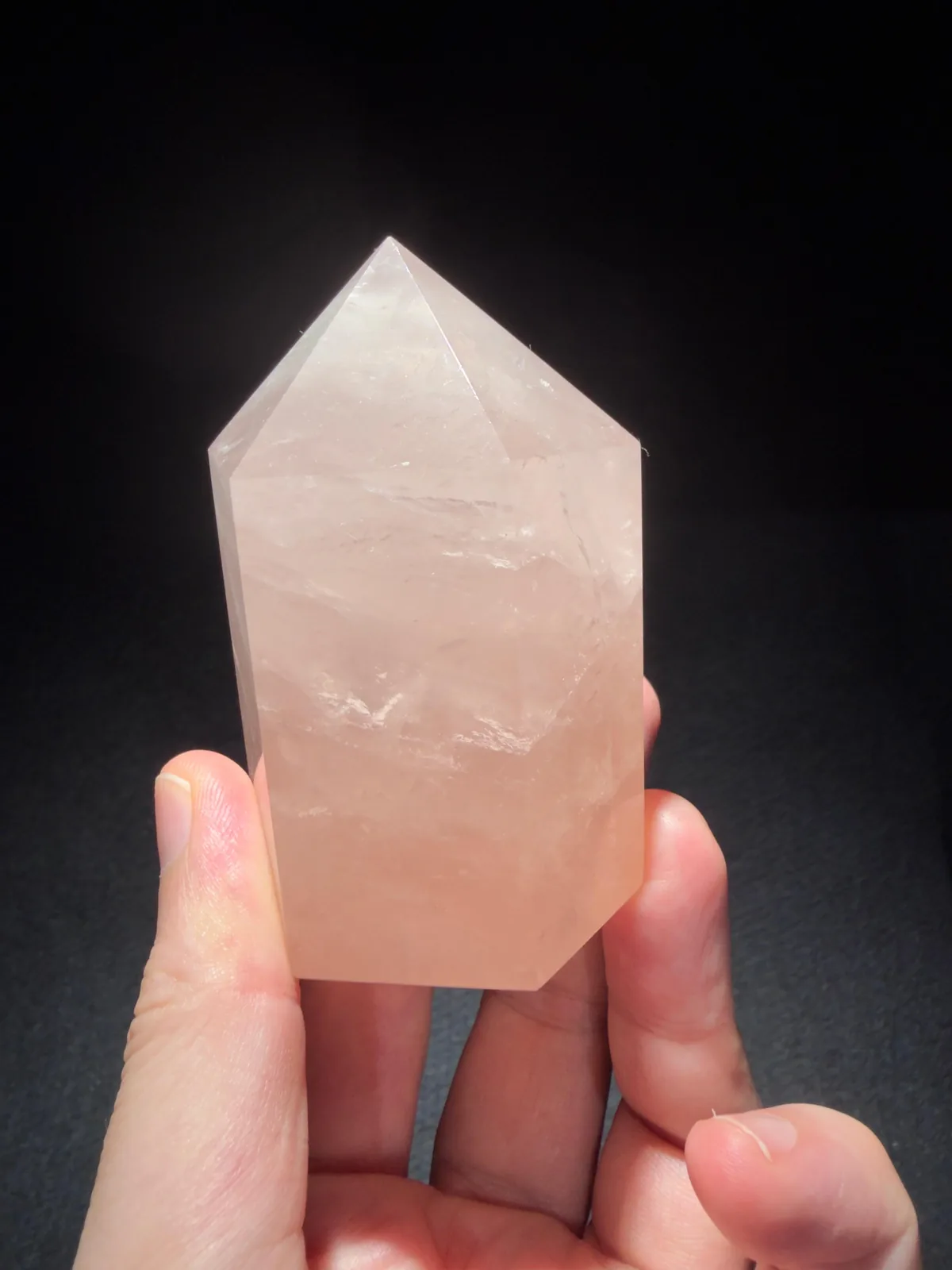
Nearly every quartz variety reaches a collector as crystals with flat faces. Amethyst, citrine and smoky quartz all arrive that way. Rose quartz arrives as tumbles, spheres, carved points and translucent lumps, because the common material does not have crystal faces at all.
There is a second pink quartz that does form crystals. It is a different material, with a different colour mechanism, and it behaves in the opposite way in light. Both are sold under the same name.
What "massive" actually means
The words here are standard petrographic terms — the vocabulary of rock description — rather than trade shorthand.
- Euhedral — showing "perfect or nearly perfect crystal faces", so that you can see the mineral's characteristic shape.
- Anhedral — "completely irregular in shape" and not resembling that shape at all, including grains that grew into whatever space was left between crystals already there.
- Massive — "appearing as a solid mass with no distinguishing features", a formal habit term in a university mineralogy text.
Calling rose quartz massive is correct terminology, not a dealer's euphemism. The material is "made up of many intergrown crystal subindividuals" — translucent masses of intergrown anhedral crystals.
Three sources, three strengths of claim
The absence of faces is reported from three directions.
The specialist mineralogy register is flat: "Rose quartz never forms crystals." The trade register is flatter still, GIA writing that rose quartz is "always found in massive form, so it lacks regular, flat crystal faces". The database is the careful one. mindat's wording is that "crystals of this type of rose quartz have never been found" — a statement about the record of what has been collected, not about what the mineral can do.
Nothing in these sources licenses the claim that faces on the massive-type material are impossible.
Why it has no faces
The question most people ask does not have a researched answer in any of these sources. None of them studied it, and none even offers a reason.
The general principle is available: faces are the exception rather than the rule, because most crystals in igneous and metamorphic rocks "run up against other crystals that have already formed, or ones that are growing simultaneously", which "prevents them from being their true shape". Quartz is especially prone to it, being a late arrival that fills the voids left in a rock after other minerals have taken their shapes. Applied to a pegmatite — a very coarse-grained igneous rock, and one of the settings rose quartz comes from — that would contrast a core of intergrown massive quartz with an open pocket where crystals can stand free. That is very likely the right shape of the answer. But no source here applies it to rose quartz, so it stays an extension rather than a finding.
Fibres, not quartz
The pink of massive rose quartz is not a property of the quartz. It sits in fibres of something else, trapped inside it.
The experiment that settled this is direct. Massive rose quartz from 29 pegmatite and vein localities worldwide was dissolved in hydrofluoric acid. Every sample left behind a residue of pink fibres, a tenth to half a micrometre wide, amounting to 50 to 150 parts per million by weight — and the residue's colour visually matched the quartz it came out of. Fibre mats and their parent stone show near-identical light absorption at around 500 nanometres. The authors concluded that "these nanofibrous inclusions are the cause of coloration of massive rose quartz worldwide".
What produces the colour inside the fibres is a change in the iron's charge state, not radiation. Heating them in air bleaches them; reheating under a reducing gas brought the pink back in 11 of 13 samples, consistent with iron shuttling between two charge states in what are called intervalence charge-transfer centres — pairs of iron and titanium atoms that absorb light by passing an electron between them.
Gamma-irradiating bleached fibres did not restore the colour. In the authors' words, "a radiation-induced center is not a cause of the color."
This displaced a century of competing explanations. Manganese, titanium, charge transfer inside the quartz lattice itself, and light scattered by rutile needles had all been proposed, and there had been "no consensus".
The fibres also explain the six-rayed star seen in some rose quartz: they grow in three equivalent directions at right angles to the crystal's main axis, and the star "is caused by reflections of the light from embedded fibers that intersect at an angle of 60°". An older attribution of the star to rutile needles still circulates.
What the fibres are made of is not settled. They are a borosilicate — a mineral built on boron and silicon — closely related to dumortierite. X-ray measurements give dumortierite as the best match, but infrared and Raman spectra "consistently did not exactly match the standard dumortierite patterns, suggesting that this fibrous nano-phase may not be dumortierite itself, but rather a closely related material". A follow-up study found the fibres carry a doubled repeating structure and more iron than dumortierite proper.
The phase is still unnamed; one of the authors informally calls it "dididumortierite". So "dumortierite-included" is defensible shorthand and wrong as an identity.
Two caveats ride with all of this. Both papers come from one research group, and the second was read only as an abstract, its full text paywalled.
A defect in the lattice
The crystallised material works the other way round. When a euhedral pink quartz crystal from Minas Gerais was put through the same acid treatment, it "dissolved entirely" — no fibrous residue at all, and the crystal was "nearly devoid of internal scattering".
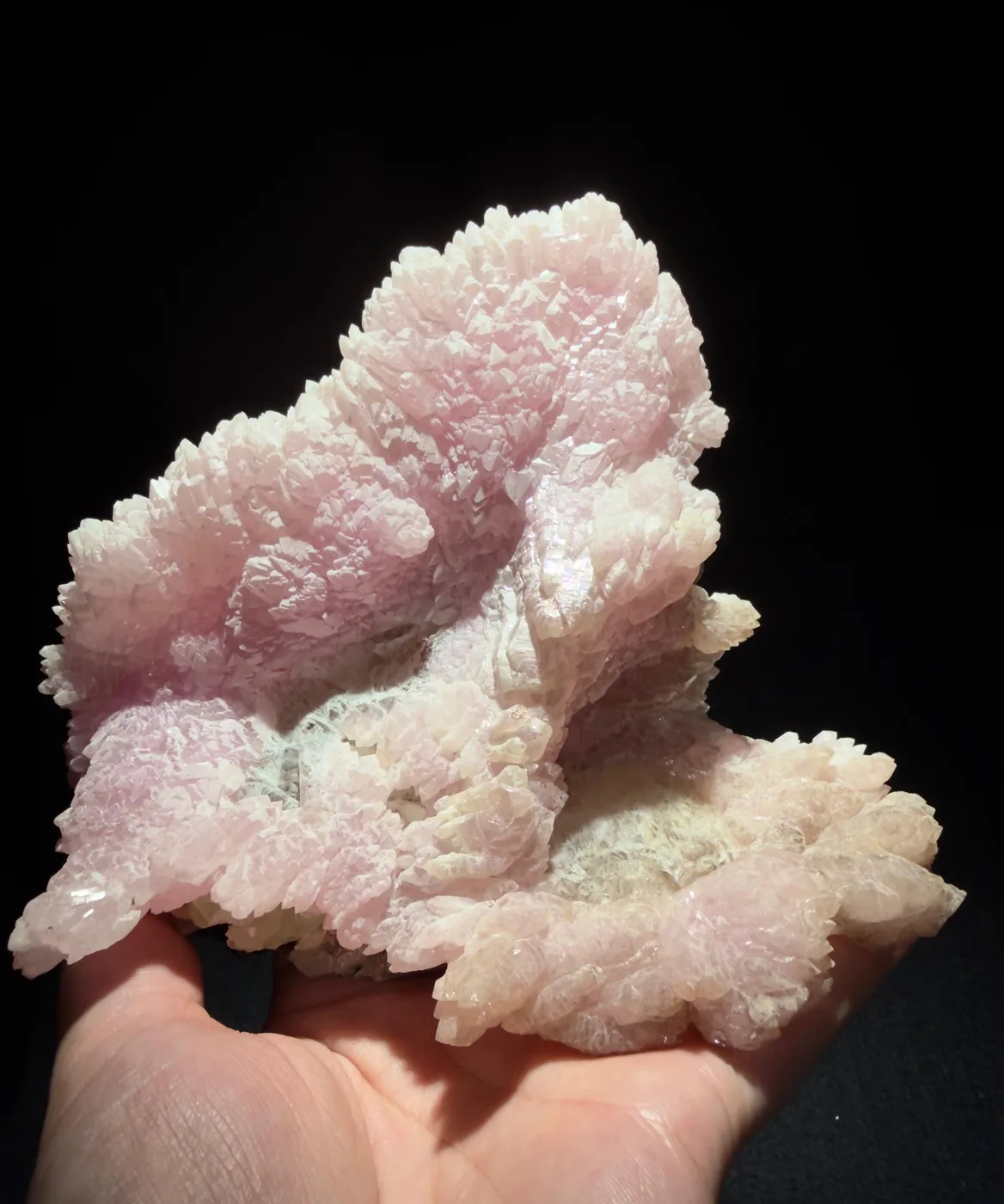
Its colour is a colour centre: a defect in the crystal's own atomic lattice that absorbs light. The published model, from 1983, is an oxygen ion carrying a trapped positive charge, bridging between an aluminium atom and a phosphorus atom that have each substituted for silicon in the lattice, with the colour switched on by natural radiation. The authors' own wording is that this is "most likely responsible" for the colour, and that the charge's position on the phosphorus side rather than the aluminium side is "assumed". It is the same family of radiation-induced defect that colours smoky quartz.
It grows in pockets. mindat records it as "a late formation in pegmatite pockets, often overgrowing smoky quartz crystals in groups of radiating to sub-parallel crystals".
The crystals are small. A specialist source notes that an individual crystal measuring 2 cm "can already be considered large"; they are translucent to transparent but rarely clear, and often grown directly on smoky quartz.
The material was first found in Brazil in 1959, and specimens still seem to come mostly from Minas Gerais. Pink crystals from Oxford County, Maine were mentioned earlier still, in a 1938 book.
The name for it never settled. Two distinguishing names were proposed — "Rosaquarz" in 1995 and "pink quartz" in 2001 — and neither found widespread use. mindat files Pink Quartz as "a synonym of Rose Quartz" and records that the name "not received widespread support". The database also files the classic Brazilian crystallised material under "Quartz var: Rose Quartz", while the locality monograph it cites for that entry is titled "Crystallized Rose Quartz".
Opposite behaviour in light
Massive rose quartz is described as "generally stable in ultraviolet light ... although there have been occasional reports of material that pales quickly in daylight", and for display purposes "insensitive to light and UV, no special requirements".
Its colour survives heating to around 500 °C. One source says about 575 °C elsewhere on the same page.
The crystallised material is very light-sensitive. A natural specimen was "completely bleached within 10 hours of UV irradiation", faster than smoky quartz or amethyst, and it pales at around 200 °C. The advice in the sources is to keep such specimens dark.
That figure describes deliberate ultraviolet irradiation, offered as an illustration alongside a photograph. It is not a measurement of what happens in a lit cabinet, and no fade rate under display or ambient light appears in any of these sources. The direction of the effect is established; its pace under ordinary conditions is not.
The two registers also differ on whether the fading reverses. GIA writes that material from some Brazilian deposits "will fade when exposed to natural light, but its color can be restored by irradiation". The 1983 primary uses a different word: the centre "slowly bleaches in UV light and can be enhanced by X-ray irradiation". Enhanced is not restored.
Field reports on the massive material conflict. Brazilian mine-dump material was reported in 1991 to have "turned milky white over a few years", while other dumps show no fading after fifty years and more. The team behind the fibre work observed no fading in any of their samples, have no experimental result on it, and offer only labelled speculation. The mechanism of that occasional fading is open.
What the name pins
One name covers both referents, and the attempt to split them failed. The same name is also "occasionally used for quartz that is coloured by other inclusions", a third and incorrect usage. A specimen labelled rose quartz may be the massive material coloured by trapped fibres, or the crystallised material coloured by a radiation-induced defect in its own lattice, and those two have opposite requirements for how they are kept.
The pink of the common stone is not the quartz's own — it belongs to fibres of something else caught inside it. The pink of the rare one is in the quartz itself. The name does not distinguish them; only the material does.
Recommended Pieces
Information in this article is current as of August 2026.
← All journal entries