What Morganite Actually Is
Emerald's mineral and aquamarine's mineral, coloured pink by manganese and named in 1911 for an American banker — and routinely confused with three other stones.
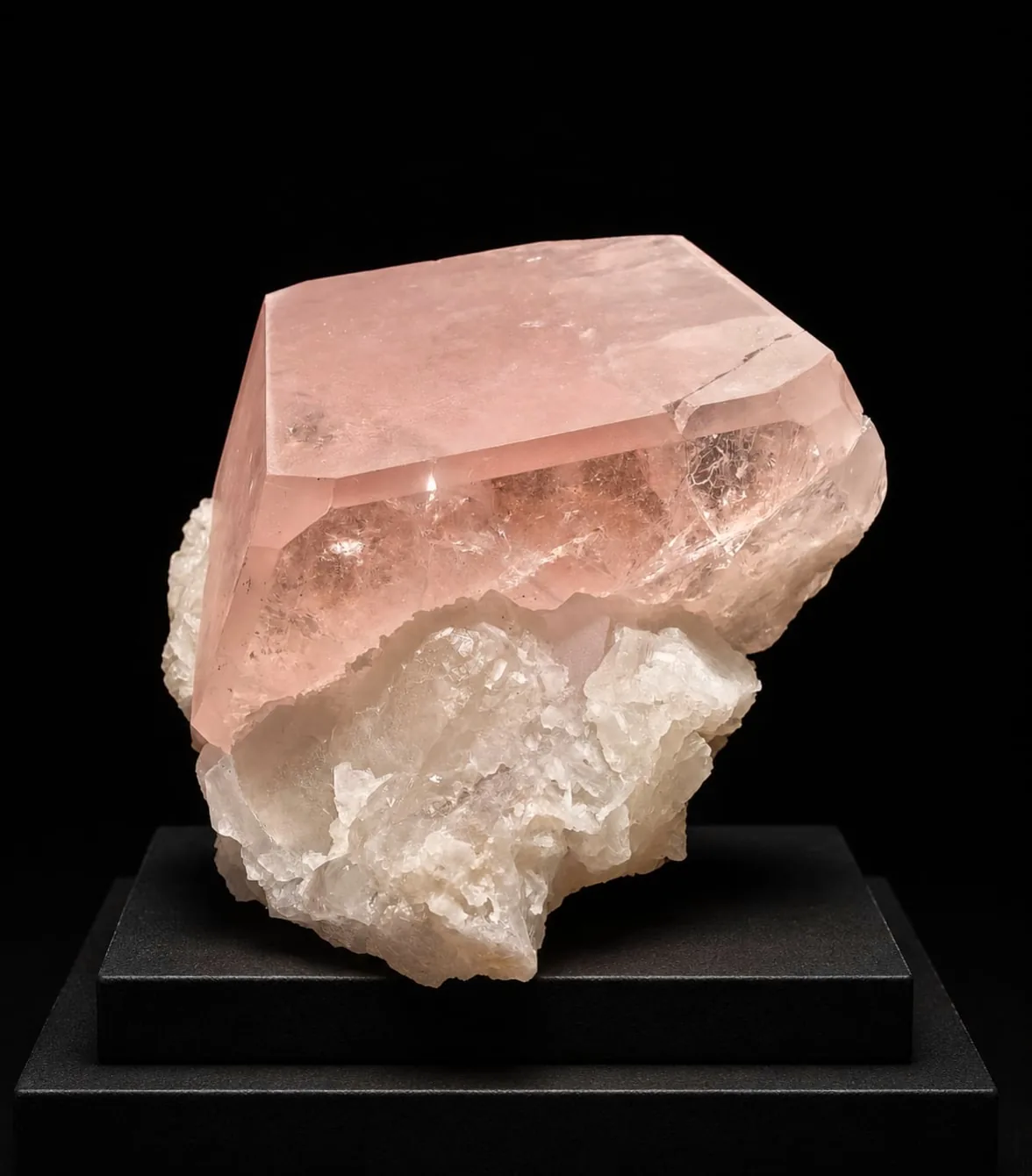
Most people meet morganite as a colour before they meet it as a mineral: a pale, slightly peachy pink.
Morganite is beryl. The same mineral as emerald. The same mineral as aquamarine. One formula — Be₃Al₂Si₆O₁₈, a beryllium aluminium silicate — growing in the hexagonal, or six-sided, crystal system. Emerald, aquamarine and morganite are not relatives; they are one species under three names.
Why it is pink
The colour comes from manganese, an impurity sitting in a lattice that would otherwise be colourless.
A directly measured morganite spectrum assigns the pink of the beryl to a broad absorption band from Mn³⁺ at around 567 nm — manganese in a particular charge state, absorbing a slice of green-yellow light and leaving pink behind. The wider gemmological literature puts it more broadly: colour "is attributed to manganese, both Mn²⁺ and Mn³⁺", producing absorption bands between 450 and 600 nm, whose exact position and number depend on the strength and symmetry of the local crystal field — the electrical environment the manganese sits in.
GIA notes that "strong hues in morganite are rare, and gems usually have to be fairly large to achieve the finest color."
The banker
mindat records the naming in 1911 and cites the paper that did it: G. F. Kunz, "Morganite, a rose-colored beryl," in the American Journal of Science. The honour went to J. P. Morgan — financier, and a serious gem collector in his own right.
A gem-trade source puts a slightly different frame around it, tying the name to a 1910 find in Madagascar and to Tiffany & Co introducing the stone to the American market. The two dates are not in conflict: one is the find, the other the naming.
Where it comes from
The host rock is pegmatite. As a body of magma crystallises, the elements ordinary minerals leave behind — beryllium among them — concentrate in what remains and grow into oversized crystals; beryl is a beryllium mineral. The gem material comes from the pockets: open cavities inside the pegmatite where crystals grow freely into empty space rather than jostling against their neighbours, which is why the best of them come out with clean, sharp faces.
mindat's page for morganite shows 180 localities. Among them are Minas Gerais in Brazil, Madagascar, Mozambique, Gilgit-Baltistan in Pakistan, and the Pala and Mesa Grande districts of San Diego County, California — the Himalaya, Stewart, Tourmaline Queen and Pala Chief mines among them.
It also comes from Kunar and Nuristan in Afghanistan, including the pegmatite field at Dara-e-Pech, which is the locality recorded for the specimen at the head of this article.
A locality list records where morganite has been found, not where it is being mined now.
What it is not
"Pink emerald" is a selling device rather than a description. Both stones are beryl, but they are distinct varieties of it, and the trade reference that flags the term is blunt about why it circulates: some vendors apply well-known gem names misleadingly, in its words, "to drum up interest (and prices)". mindat lists only two synonyms for morganite — Cesian Beryl and Rose Beryl. "Pink emerald" is not among them.
Goshenite is near-colourless beryl. The same trade reference notes that near-colourless beryl is sometimes offered as morganite, and says it should be labelled goshenite instead.
Pezzottaite is the subtle one, because it genuinely looks the part — a raspberry-red to pink stone, first found in Madagascar and recognised as a distinct mineral species in 2003. It is not a variety of beryl but a separate member of the beryl group, built on a caesium-and-lithium formula, and trigonal rather than hexagonal in symmetry.
On the bench
One published table puts morganite at hardness 7.5 to 8 on the Mohs scale, with indistinct cleavage — no plane of easy splitting to catch a knock.
The short version: morganite is pink beryl, coloured by manganese, named for a banker in 1911, and found in pegmatites from Brazil to Afghanistan to California.
Recommended Pieces
Information in this article is current as of September 2026.
← All journal entries