The Trapiche Emerald — A Wheel Inside the Stone
A rare Colombian emerald grows a six-spoked wheel of dark carbon inside the green — a pattern that records the exact moment its own growth was interrupted.
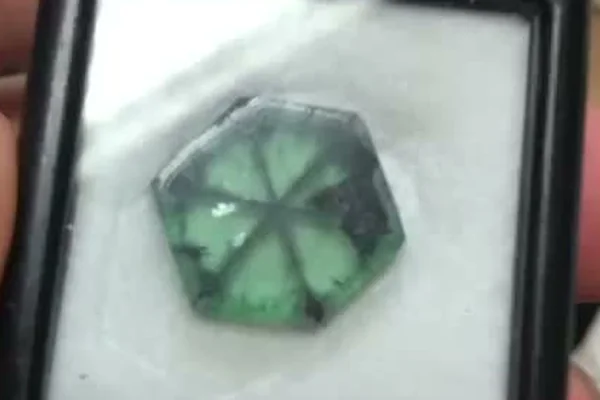
Almost everything prized in an emerald is about what it lacks — the fewer inclusions, the better. The trapiche emerald turns that instinct on its head. Its entire appeal is a fixed pattern of dark inclusions, arranged in a six-armed wheel locked inside the green.
What the pattern is
Cut a trapiche emerald across and you find four things: a central hexagonal emerald core, six dark radial arms — the "spokes" — six trapezoidal sectors of clearer emerald between the arms, and often a clean, gem-quality overgrowth wrapping the whole. The name comes from the trapiche, the spoked wheel of a traditional Colombian sugar-cane mill, which the cross-section resembles.
One distinction matters, because the trade blurs it. A true trapiche is a structural pattern — solid inclusions sitting along the crystal's growth boundaries. A "trapiche-like" stone shows a similar radial look produced by colour-zoning instead. They resemble each other and form quite differently; the true trapiche is the structural one.
What the dark spokes are made of
The arms are not shadow or flaw in the usual sense — they are carbonaceous matter, most likely of organic origin, together with albite (a common feldspar) and traces of the host rock: quartz, mica, carbonates, pyrite. In other words, the spokes are, in effect, the carbon of the black shale the emerald grew among — caught and held along the crystal's boundaries. The stone carries a trace of its own birthplace.
How the wheel forms
The favoured explanation is a model of interrupted growth, set out by Pignatelli, Giuliani and colleagues in 2015. It is widely cited and is the leading account — though it originates substantially with one research group and has not been independently replicated, so it is best held as the best current model rather than proven fact. In plain terms:
- A clear hexagonal core crystallises first, under calm, stable conditions.
- Growth is then interrupted — a change in the fluid feeding the crystal — which lets impurities and host-rock matter gather.
- When growth resumes, clean beryl builds on the flat faces, while at the six corners emerald and albite grow together at once (a eutectic, where two minerals crystallise side by side). Because beryl is naturally six-sided, the dark carbonaceous matter settles preferentially along those six boundaries — forming the spokes.
- The growing crystal pushes the soft matrix outward rather than trapping it evenly, sharpening the geometry into clean rays.
- A final gem-quality overgrowth seals the core, arms and sectors into a single crystal.
Step back and there is a bigger picture. This happens where fluid pressure builds at fault tips in the black shales and then suddenly releases. That abrupt drop in pressure leaves the fluid briefly holding far more dissolved mineral than it can keep — a state called supersaturation — so emerald crystallises in a rush. It is precisely this burst of rapid, unstable growth that the trapiche pattern records: the wheel is a snapshot of a crystal made too fast to stay clean. Only the tectonics of Colombia's western emerald belt supply those conditions.
Rarity and why collectors want them
Trapiche emeralds are genuinely uncommon — under 0.1% of production at classic mines such as Muzo and Peñas Blancas. The traditional sources are the Colombian mines (Muzo, Coscuez, Peñas Blancas, La Pita), with a handful of finds since reported in Brazil and Madagascar.
They are valued differently from ordinary emerald: not for flawless clarity, but for a sharp, well-centred, evenly-spoked wheel. Cut as slices or cabochons to show the pattern face-on, a fine trapiche is a genuine rarity to own.
Where a fine emerald hides its history, a trapiche wears it — six spokes of carbon from the very rock it grew among, held inside the green.
Recommended Pieces
Information in this article is current as of June 2026.
← All journal entries