The Blue That Was Dyed On
In 2020 a wave of electric-blue "Mexican hemimorphite" swept the mineral market. It was beautiful, it was convincing — and much of the colour had been added with industrial pigment.
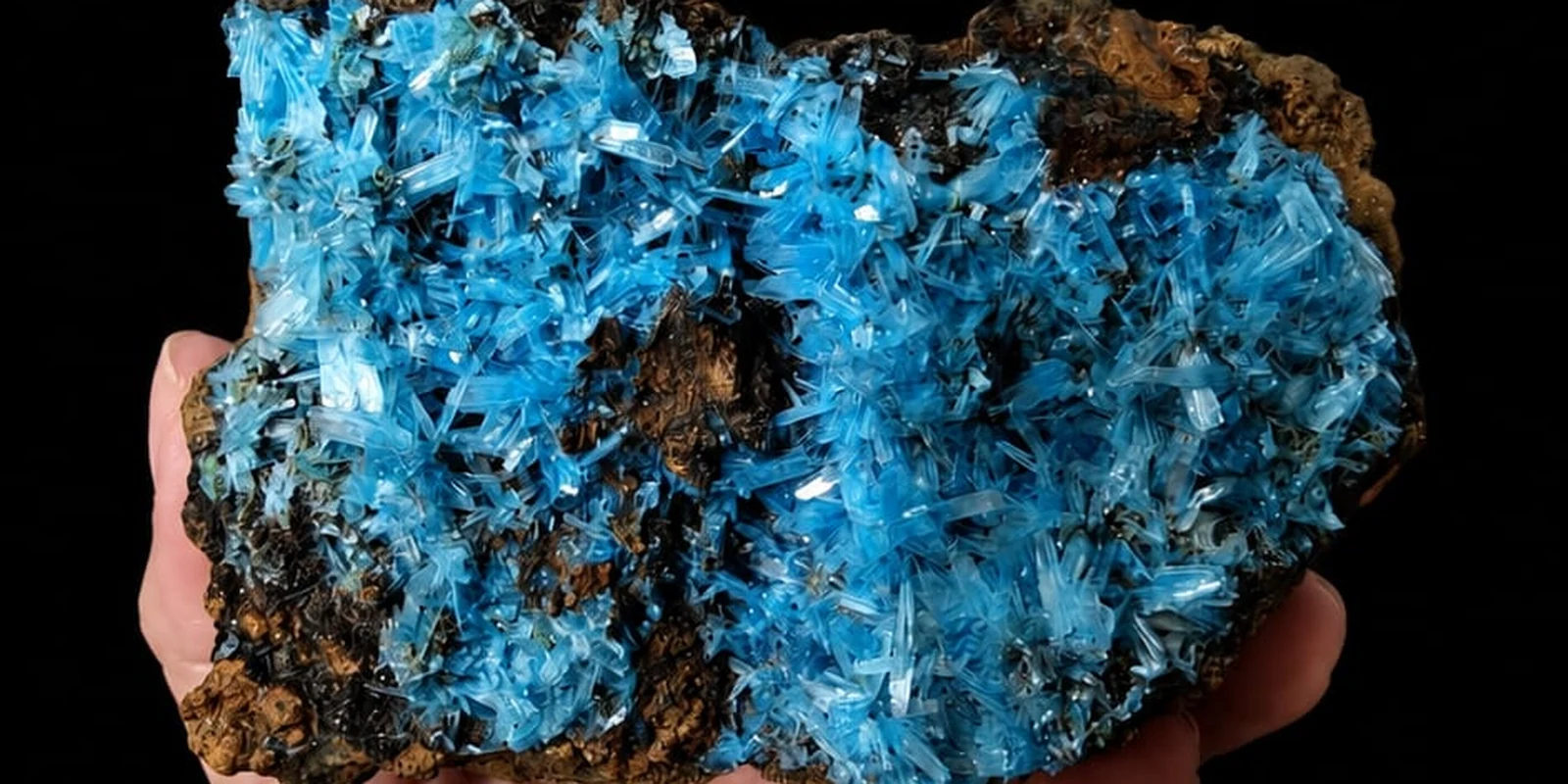
In 2020, a run of astonishing electric-blue crystals appeared on the mineral market, said to be a new discovery from the famous Ojuela mine at Mapimí, in Durango, Mexico. The colour was shocking — a saturated, glowing blue that the locality had never produced before. That was exactly the problem. Testing soon showed that much of this material was not naturally blue at all. It had been dyed.
The mineral underneath was real, and its story is worth knowing — both because it is a genuinely lovely stone and because the episode is a small masterclass in how a convincing fake gets made, and how it gets caught.
What hemimorphite actually is
Hemimorphite is a zinc silicate — a mineral built from zinc, silicon, oxygen and water, formula Zn₄Si₂O₇(OH)₂·H₂O. It forms as a secondary mineral, meaning it grows later, when the weather and groundwater slowly alter an existing zinc ore near the surface. It is soft to middling on the hardness scale (about 4.5 to 5 out of 10) and often appears as delicate fans, crusts and botryoidal (grape-like) masses.
It also carries one of mineralogy's classic identity mix-ups. For centuries hemimorphite was lumped together with a different zinc mineral, smithsonite (a zinc carbonate), under the single old name "calamine." The British mineralogist James Smithson showed around 1803 that these were two distinct species, and the naming was formally settled in the twentieth century. They still look alike and often grow together, so mineralogists tell them apart by weight and acid reaction rather than by colour — a reminder that with these blue-green zinc minerals, the eye is easily fooled.
A rare blue, honestly explained
Most hemimorphite is white, grey, colourless or brown. Genuinely blue and blue-green crystals are the prized minority, and that scarcity is what made the 2020 material so tempting. The colour is generally attributed to traces of copper (with some iron) sitting in the crystal — the same element that colours turquoise. It is worth being precise here: this copper explanation is the accepted view in the trade rather than something proven by a dedicated laboratory colour study, and we present it as such. What is certain is that natural blue hemimorphite exists — the classic examples come from Wenshan in China — and that it is genuinely uncommon.
The dye that beat every test
The 2020 fakes were clever precisely because the faker chose a difficult pigment. Analysis reported by Fine Minerals International, from work by Dr. John Rakovan of Miami University, identified the colour as Phthalocyanine Blue BN — a common synthetic pigment used in dyes and paints — confirmed by Raman spectroscopy, a technique that reads a material's molecular fingerprint. (That specific identification rests on this one widely-cited 2020 analysis.)
Two things made it hard to spot. First, the pigment is stubborn: it will not dissolve in water or in the solvents a collector normally dabs on to test for dye, and it resists acid. The usual home tests simply come up blank.
Second — and this is the elegant trap — the pigment itself contains copper. So when a specimen is checked with a routine chemical scanner (the kind that lists which elements are present), it reports copper sitting on zinc-bearing hemimorphite. That is exactly what a naturally copper-coloured blue hemimorphite would look like. Finding copper, in other words, does not prove the colour is natural. The clues that did give it away were physical: the colour sat as an uneven film on the surface, showed signs of having dried on, and spared the surrounding rock. The definitive answer came only from Raman spectroscopy, which sees the organic dye that the element scan misses.
The honest version
None of this makes blue hemimorphite a stone to avoid. Genuinely blue-green material is real — the classic examples come from Wenshan, in China — and the mineral beneath the 2020 dye was true hemimorphite. The lesson is narrower and more useful: with these blue-green zinc minerals, colour alone settles nothing, and the very copper that would explain a natural blue also hides inside the pigment that faked it. What tells the two apart is not the eye but the evidence — an uneven film of colour that spares the surrounding rock, and a Raman signature that reads the dye where an element scan cannot.
Information in this article is current as of July 2026.
← All journal entries