Ruby and Sapphire Are the Same Mineral
The two most famous coloured gems in the world are one mineral wearing two names — and the difference between them comes down to a handful of stray atoms.
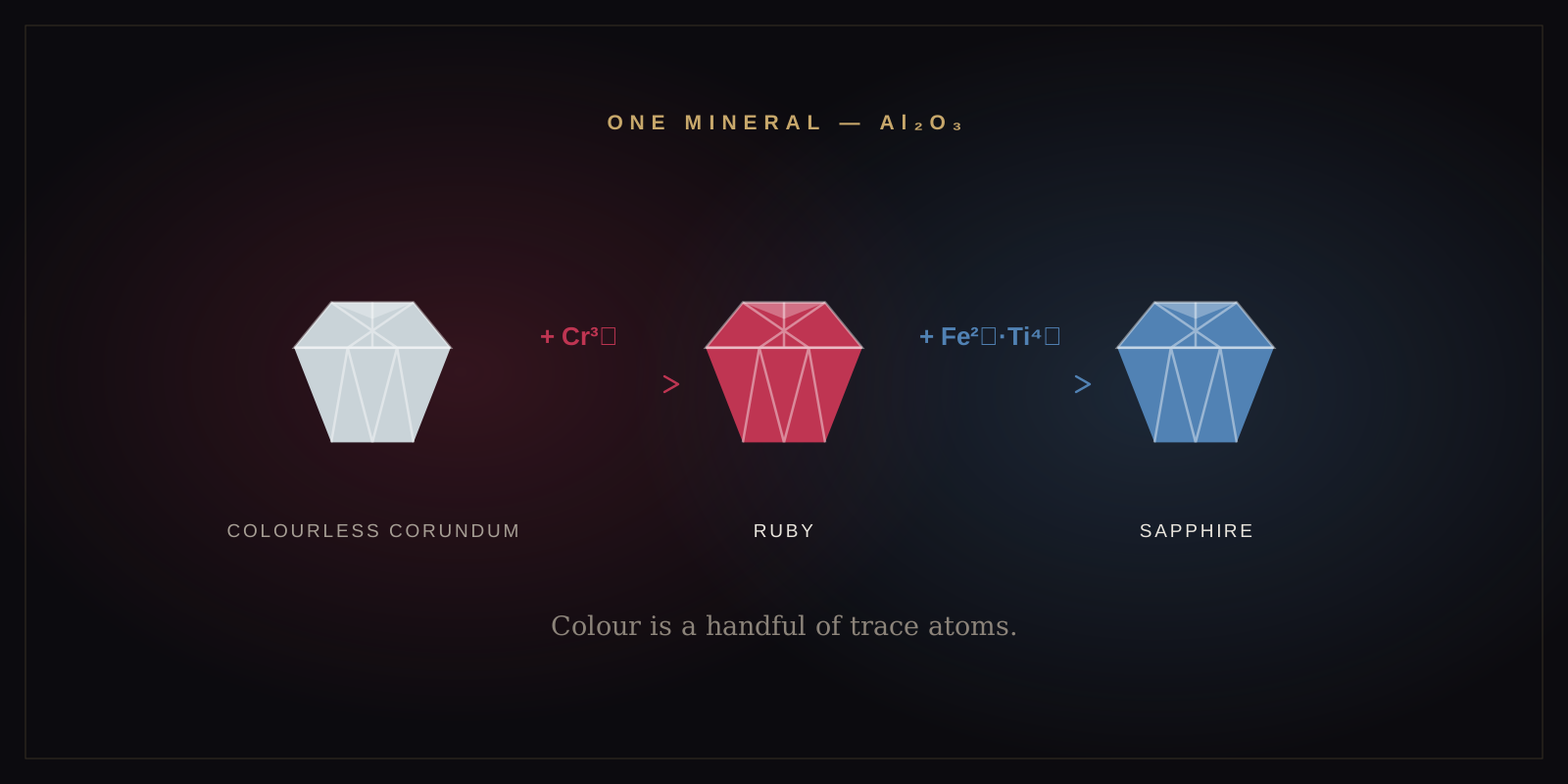
Here is a fact that surprises almost everyone outside the trade: ruby and sapphire are not two different gemstones. They are the same mineral — corundum — separated only by colour. By long-standing gemological convention, red corundum is called ruby, and corundum of any other colour is called sapphire. There is no deeper species boundary between them, no difference in the underlying crystal. Understanding that single point tells you most of what is worth knowing about this family of stones.
One crystal, two names
Corundum is crystalline aluminium oxide — the compound Al₂O₃, aluminium and oxygen locked in a repeating lattice. In its purest form it is completely colourless. It is also extraordinarily hard: it sits at 9 on the Mohs scale (the standard 1-to-10 scratch-hardness ladder), making it the hardest common mineral after diamond. In fact corundum is the reference point for 9 on that scale.
So the raw material is a hard, clear crystal. Everything that makes one piece a ruby and another a sapphire happens because of impurities — a few foreign atoms that slip into the lattice as the crystal grows.
Colour is a matter of a few atoms
The atoms responsible are called chromophores: trace elements whose presence in the crystal absorbs some wavelengths of light and lets others through, which is what we perceive as colour. In corundum they are present in tiny quantities, but a little goes a long way.
Research by the Gemological Institute of America (GIA) identifies six major chromophores in natural corundum: chromium (Cr³⁺), iron (Fe³⁺), vanadium (V³⁺), an iron-and-titanium pair (Fe²⁺-Ti⁴⁺), and two more exotic ones the researchers call "trapped holes" bound to iron or chromium. A trapped hole is simply an oxygen atom carrying an unusual electric charge — and it turns out to be an especially strong absorber of light, producing intense golden-yellow or orange tints.
Chromium is the one that makes a ruby. When chromium takes the place of some aluminium atoms, it colours the crystal red — and, as GIA notes, the more chromium present, the stronger that red, ranging from an orangy red through to a purplish red. The iron-and-titanium pair, in standard gemmological understanding, is what gives blue sapphire its colour. (That the Fe²⁺-Ti⁴⁺ pair produces blue is long-established gemmology rather than a finding of the GIA colour study cited here.)
Why most stones are a blend
It would be tidy if each colour came from a single chromophore, but nature is rarely that clean. The GIA research is explicit on this: gem corundum is rarely coloured by just one chromophore. The vast majority carry a combination of two or three, and the colour you finally see is the sum of the light each of them absorbs.
That is why corundum comes in such a range — not only red and blue, but pink, yellow, the orange-pink "padparadscha", green, and colourless "white" sapphire. Each shade is a different recipe of the same handful of ingredients, stirred into the same clear crystal.
Where the line is drawn
Because the ruby/sapphire split is purely a matter of colour, the boundary is a human judgement, not a natural one. Red is ruby; everything else is sapphire. The interesting edge is where red fades into pink — there, whether a stone is called a "ruby" or a "pink sapphire" is a long-standing judgement call for the trade and the laboratories, and reasonable experts can disagree. Nothing about the crystal itself changes across that line; only the name does.
It is worth holding onto how much rests on how little. A ruby and a blue sapphire can be, atom for atom, almost entirely identical — the same aluminium oxide, the same hardness, the same optical character. What separates the two most storied names in the coloured-gem world is a scattering of chromium here, or iron and titanium there, distributed through an otherwise colourless stone. The gems are a study in how small a cause can carry how large a reputation.
Recommended Pieces
Information in this article is current as of July 2026.
← All journal entries