The Heavy Stone That Named an Element
Scheelite is dense enough to feel wrong in the hand and glows blue-white under ultraviolet light. It gave the element tungsten its name, shows its crystal structure in its shape, and grows where granite meets limestone.
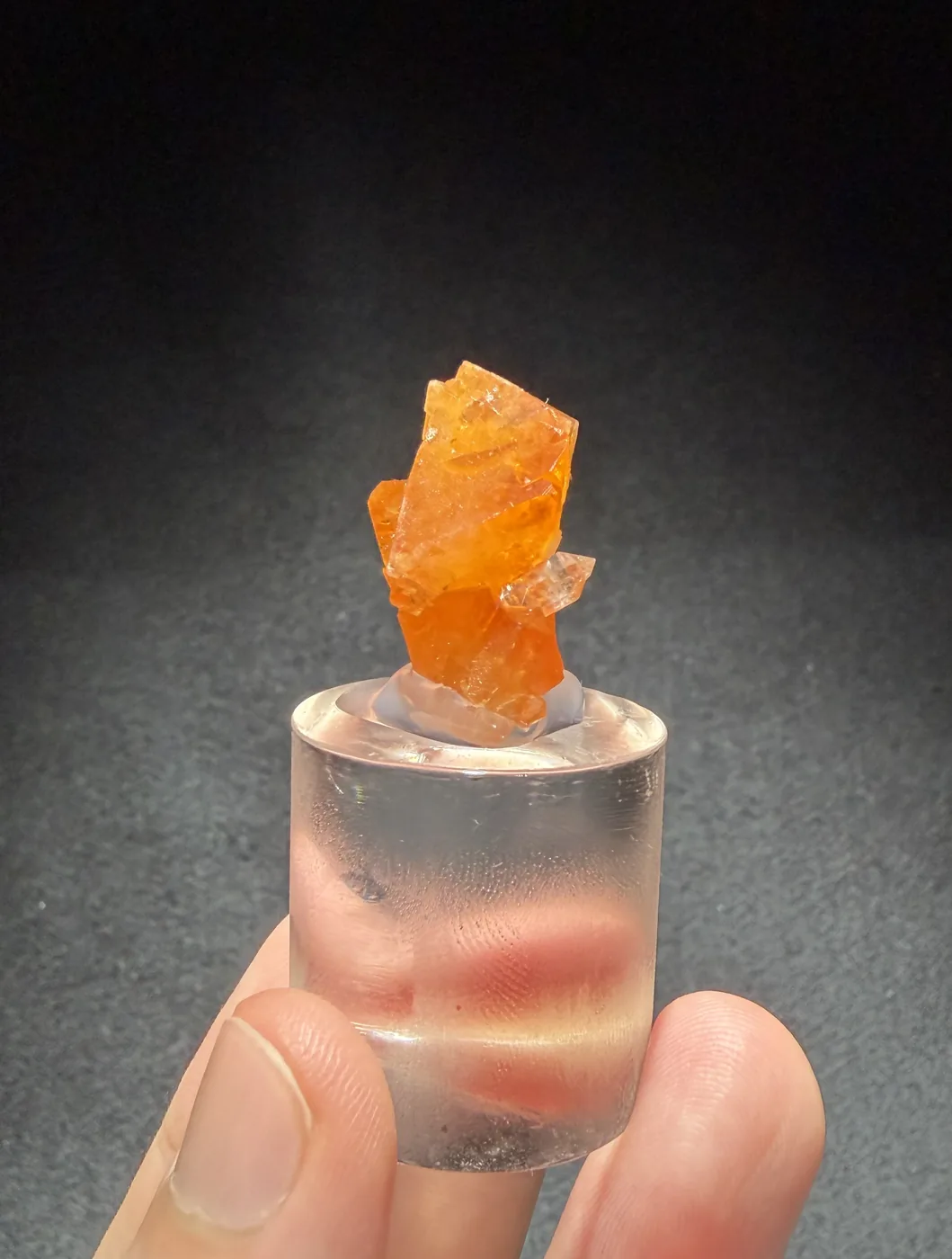
Pick up a scheelite and the first thing you notice is the weight. For a pale, glassy, often translucent stone it is startlingly dense — a specific gravity (its weight against an equal volume of water) of about 5.9 to 6.1. Put it under a short-wave ultraviolet lamp and it does the second surprising thing: it glows a bright bluish-white. Miners once used exactly that glow to find it in the dark.
Scheelite is calcium tungstate, CaWO₄ — a compound of calcium, tungsten and oxygen — and one of the two minerals the world's tungsten is mined from. The other is wolframite, an iron-manganese tungstate.
The stone that named the metal
The word tungsten is Swedish: tung sten, "heavy stone." That was the mineral's name before it was the metal's. In 1781 the Swedish chemist Carl Wilhelm Scheele took the heavy stone and drew from it a new substance, tungstic acid — an oxide of a metal no one had yet isolated. He did not isolate the metal itself. Two years later, in 1783, the Spanish chemists Juan José and Fausto Elhuyar did — reducing tungsten oxide, obtained from the mineral wolframite, with charcoal to produce the metal for the first time.
The element ended up with two names, tungsten and wolfram, both in use since its discovery. The chemical symbol W, fixed by the chemist Berzelius, prevails everywhere regardless of which name is used; it is not scheelite's.
The mineral got its own name later. In 1821 Karl Caesar von Leonhard named it scheelite, after the man who, forty years before, had first drawn the element's oxide out of it.
Why the crystals look like double pyramids
Scheelite is tetragonal: its atoms sit on a lattice with a square cross-section, stretched longer in one direction than the other two. When it grows well-formed crystals they are usually pseudo-octahedral — bounded by the faces mineralogists label {011} and {112} (bracketed numbers called Miller indices, a shorthand for how a face is angled across the crystal's axes). Those faces together give the crystal the look of two four-sided pyramids joined base to base: a bipyramid. Sometimes the crystals are tabular, flattened on the {001} faces, and the pyramid faces often carry fine diagonal striations, small parallel grooves. Scheelite also occurs with no good crystals at all — granular, massive, or in columns.
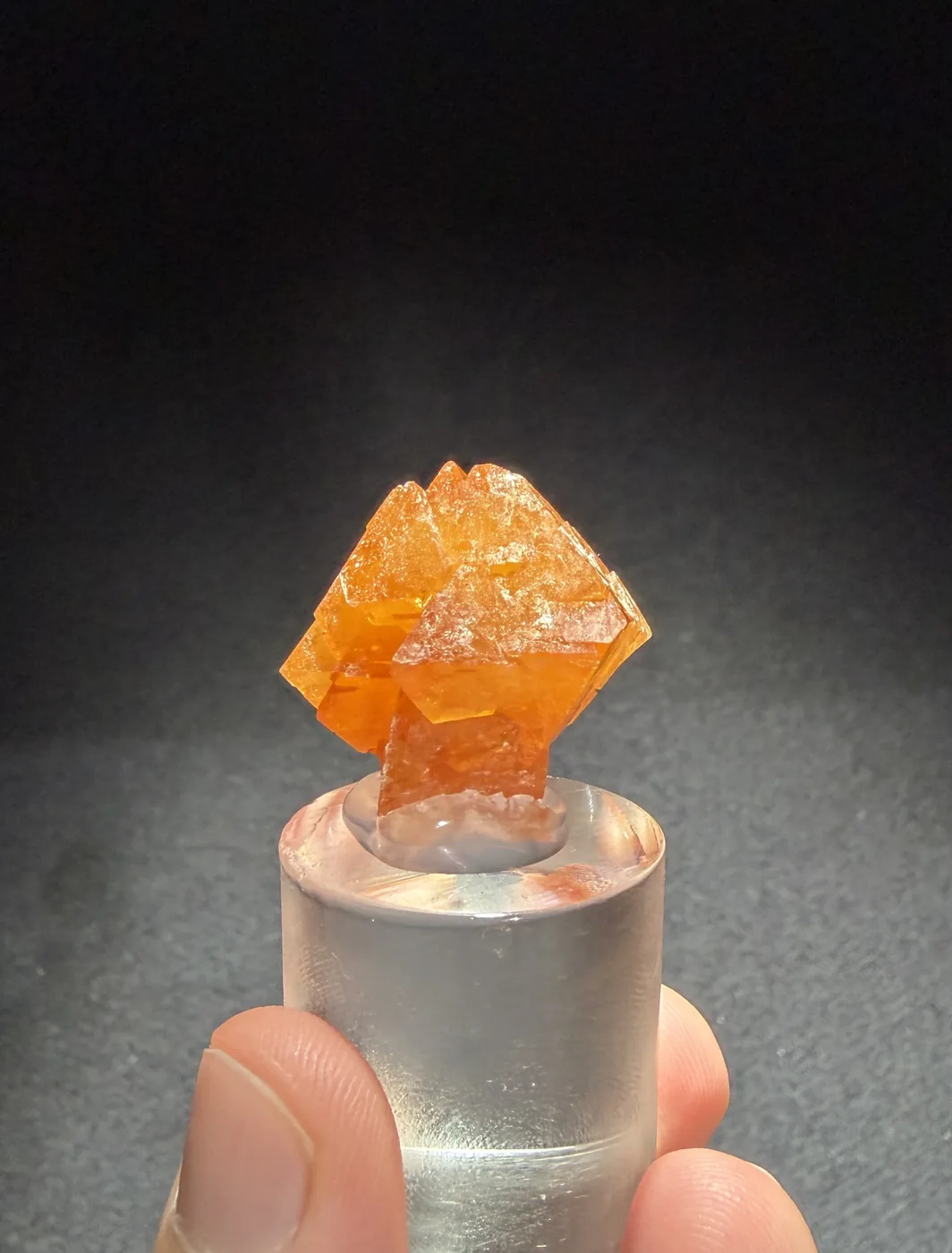
It twins readily. Twinning is where two crystals grow together in a fixed, mirror-like relationship rather than at random. In scheelite the twin plane is {110}, and the twins come both as penetration twins, grown through one another, and contact twins, joined along a shared surface. Whatever outward shape a scheelite takes, it also has a distinct cleavage on {101} — a direction along which it splits cleanly.
Where it forms
Tungsten minerals form mostly from hot, water-rich fluids given off by cooling granite. Whether such a fluid grows scheelite or wolframite depends partly on the rock it invades: scheelite, the calcium tungstate, is favoured where the fluid meets a calcium-rich host.
The classic setting is a skarn — the rock made where a granite intrusion pushes against limestone or dolomite and the hot fluids replace the carbonate with a new assemblage of calcium-silicate minerals (garnet, pyroxene, wollastonite). Scheelite crystallises among them, alongside molybdenite, chalcopyrite and pyrite. The calcium comes from the limestone, and that is what tips the balance toward calcium tungstate rather than the iron-manganese wolframite. Individual skarn orebodies are usually small, yet the two largest known tungsten deposits — Shizhuyuan in Hunan, China, and MacMillan Pass in Canada — belong to this broad skarn family.
Beyond skarns, scheelite turns up in other granite-related settings: in greisen (a quartz-mica rock altered by late magmatic fluids near the top of a granite), in high-temperature quartz veins, and, less often, in pegmatites (very coarse-grained granite). In most of those the tungsten is usually wolframite, with scheelite the subordinate one — except in veins tied to less-evolved intrusions, where scheelite can be the more abundant of the two.
One large deposit breaks the pattern. Felbertal in Austria is a stratabound body, layered into metamorphic rock rather than sitting in a skarn, thought to have begun as a volcanic-exhalative deposit and later reworked into veins.
As an ore, and as a specimen
Scheelite and wolframite are the two tungsten ores mined today; the metal is only exceedingly rarely found native (uncombined in nature), so in practice it all comes from these ores. The two are treated differently because their chemistry differs — scheelite, the calcium tungstate, is broken down with hot hydrochloric acid, while wolframite, the iron-manganese one, is fused with soda. Most tungsten mine production comes from skarns together with wolframite-bearing quartz veins and stockworks, and China supplies the large majority of world output.
Scheelite ranges in colour from colourless and white through grey and brown to yellow, orange, red and green — and, rarely, a dark, almost greyish purple. The finest, sharpest crystals a collector sees come from Xuebaoding, near Pingwu in Sichuan, China — typically a deep, dark orange. Good specimens and tungsten production are also tied to Pine Creek in California, King Island in Tasmania, the Cantung and Mactung mines in Canada, Sangdong in South Korea, and Siberia; Pakistan is a more recent source, its crystals a darker, reddish orange. Most specimens are only weakly translucent, clearest at the crystal tips — large, fully transparent, complete crystals are exceedingly rare. Some famous tungsten districts are not scheelite sources at all: Xihuashan in China and Panasqueira in Portugal are worked for wolframite.
A scheelite specimen carries the whole story in the hand — too heavy for its size, bright under the lamp, its double-pyramid shape a readout of the lattice inside, and named, in the end, for the chemist who first drew an element out of a heavy stone.
Information in this article is current as of September 2026.
← All journal entries