How an Amethyst Geode Forms
The giant violet cathedrals begin as nothing at all — an empty pocket swelling inside altered volcanic rock, then filled drop by drop. The leading explanation is stranger than the textbook one.
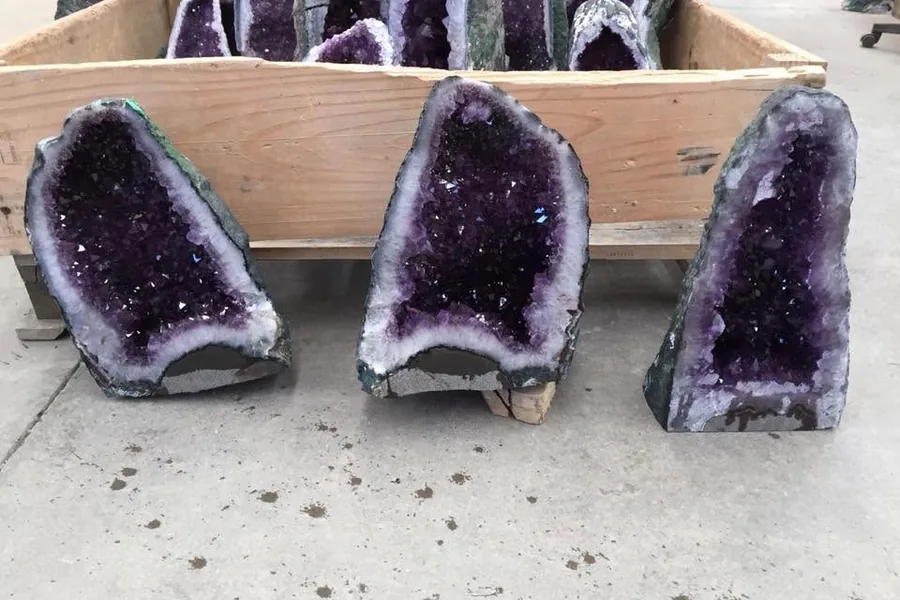
The great amethyst "cathedrals" — the metre-tall geodes lined with violet crystal that anchor a serious collection — come almost entirely from one place: the Paraná volcanic province of southern Brazil and Uruguay, the largest source on Earth. There they sit, some up to five metres across, embedded in the solid core of ancient basalt lava flows around 135 million years old.
That last detail is where the familiar story starts to fall apart.
The textbook story, and its problem
The version most people are told is that a geode is a gas bubble: molten lava cools, trapped gas leaves a hollow, and crystals later grow inside it. It is a tidy picture — and for many small geodes it is broadly right.
But the giant Paraná geodes do not sit in the frothy, bubble-filled crust of a lava flow. They sit deep in its massive core, unconnected to that bubbly zone. A gas bubble cannot easily explain a five-metre cavity in solid rock. So how does the pocket — the cavity, the void that later fills with crystal — actually open?
The leading model: ballooning
The explanation now favoured by researchers is, quite literally, that the rock balloons. It comes from a 2012 study by Hartmann and colleagues, and it is worth saying plainly that this is the leading model rather than settled fact — it is argued largely by one research group and set against older ideas, including a high-temperature gas-degassing model. With that caveat, the picture it paints is compelling, and it works in two stages: first the cavity opens, then it fills.
Stage one — the cavity opens. Hot water first alters the hard basalt into a soft, clay-rich rock, something closer to mudstone — around fifty times less stiff than the original. In that soft, pliable rock, the pressure of water vapour can inflate a void, swelling it open like a bubble in dough, at surprisingly low temperature (below 150 °C) and under just five to twenty metres of cover. Unaltered basalt is far too stiff for this; it can only crack. The rock has to be softened first for a cavity to grow at all.
The shape follows from how that soft rock yields: some cavities stretch into a cigar form, others flatten into a saucer. The size tracks how much rock lay on top — more overburden, more pressure, bigger geode.
Stage two — the cavity fills. Long after the pocket forms, silica-rich hot water percolates through and deposits silica minerals on the walls at low temperature, around 50 °C. The silica builds up on the walls, with the amethyst points forming last, growing inward toward the centre — which is why a finished geode is crusted with crystal around a hollow core.
Where the purple comes from
The violet itself is a separate story from the cavity. Amethyst's colour is an iron-and-irradiation effect: trace iron sits within the quartz structure, and natural radiation over geological time alters it into a light-trapping defect — a colour centre — that we see as purple. The colour is rarely even; look closely and it often deepens toward the crystal tips and pales toward the base.
Reading a geode
A finished geode still records how it was made — the soft altered rock that let the cavity balloon, the silica lining, and the amethyst points with their uneven colour, each marking a stage in the long sequence from empty pocket to filled crystal. Collectors prize even colour, water-clear crystal, and undamaged terminations; but whatever the grade, that history is written into the piece.
A geode is not carved. It is inflated, then filled — a void swelled open in soft rock, and lined with crystal by water that had long forgotten the fire.
The ballooning model above is the current leading explanation and remains an active area of research; we've framed it as researchers do, not as final word.
Recommended Pieces
Information in this article is current as of June 2026.
← All journal entries