Tanzanite — Three Colours from One Hill
Every tanzanite on Earth comes from a single hillside in Tanzania — and inside each crystal are three different colours at once, depending on the angle you look through.
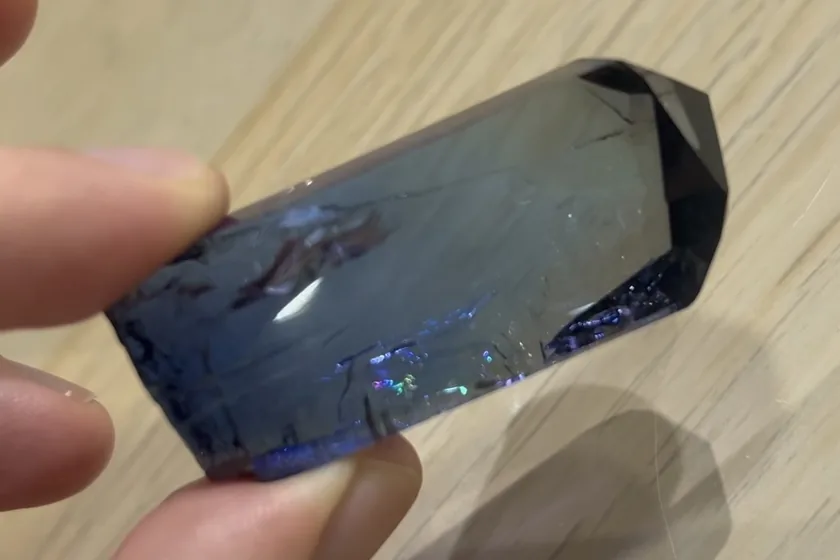
Tanzanite came to the trade only in the 1960s, when its blue-to-violet crystals were first found and identified at the Merelani Hills of northeastern Tanzania. Every piece of it comes from that one place on Earth — there is no second source. For a collector, that lone origin is much of the appeal: a species with a single address.
What it actually is
Tanzanite is the gem variety of zoisite, a calcium-aluminium silicate; what makes it tanzanite is a trace of vanadium, which sits in the crystal structure and lends the blue-to-violet colour. The name is younger than the stone. When the blue crystals surfaced in the late 1960s, Tiffany & Co. christened them "tanzanite" in 1968 — after the gem's only home — reportedly because "blue zoisite" was a hard sell at the jeweller's counter, reading a little too close to "suicide." Their campaign promised it could be found in "two places: Tanzania and Tiffany's." So the name is a piece of marketing; the variety it names is mineralogically real.
Why only one hill
Tanzanite formed deep in the crust by regional metamorphism — the slow reworking of rock under heat and pressure — during the late, cooling ("retrograde") stage of an ancient mountain-building episode. The host rocks at Merelani began as black shale, a carbon-rich mud, later baked into graphite-bearing gneiss; the accessible study puts crystal growth at around 630 °C in a rock-buffered pocket.
The precise age is still unsettled — a figure near 550–500 million years appears in one thesis, while a more exact date quoted in some summaries turns out not to be in the peer-reviewed abstract, so it is best treated as unconfirmed. What matters for the collector is the consequence: that narrow, specific set of conditions occurs in essentially one structurally-controlled seam, which is why Merelani is the gem's only commercial source.
Three colours in one crystal — pleochroism
Tanzanite is pleochroic, and the effect belongs to the crystal itself, before anyone cuts it. It is strongly trichroic — a single crystal holds three colours at once, classically a red-violet, a deep blue, and a yellow-green, each aligned with one of its three crystal axes.
It is a directional effect, which is exactly what makes it worth seeing in the specimen. Hold a natural crystal under one steady light and, as you rock and tilt it, the colour changes with the angle you look through — not because the lighting changed, but because your line of sight is now running along a different axis of the crystal. The same property is what a cutter later exploits: a finished stone is oriented to face up in the one blue or violet chosen from the three, and a different orientation of that very crystal would read differently.
What heating does — and doesn't
Most rough tanzanite leaves the ground brownish or with a muddy yellow-green cast, because its vanadium sits in one oxidation state. Heat treatment — the trade range is roughly 400–600 °C — nudges the vanadium to a higher oxidation state (chemists write it V³⁺ → V⁴⁺). That suppresses the brown and yellow-green and brings the saturated blue-violet forward — and in doing so it shifts the stone from three-way trichroic toward a cleaner violet-to-blue. The change is stable.
Because nature so rarely finishes the job on its own, heating is the industry norm — so much so that a cut tanzanite is routinely assumed to be heat-treated unless stated otherwise. It is a standard, well-understood enhancement, not something to hide. What is worth understanding is what the treatment trades: it quiets the muddy yellow-green, narrowing the crystal's three-way colour toward a cleaner violet-and-blue. The untreated crystal is the one that still carries all three.
What it means for a collector
Two things follow for anyone collecting the species. First, if you are admiring a cut, vivid-blue stone, assume heat helped it there — nearly all tanzanite is treated, so it is the trade baseline, and it should be disclosed. Second — and this is the part a crystal shows better than a faceted stone — those three colours are a property of the crystal, held all at once; a cut gem is a single angle, chosen and then heat-fixed. From one hillside, three colours in one crystal, and a little heat to settle on one of them: that is tanzanite.
Recommended Pieces
Information in this article is current as of July 2026.
← All journal entries